
More than a year in the works, me and the fam departed Eugene in late May for a week of tent life along the Pacific Coast from the Mattole to the Chetco Rivers. We bookended our trip with pizza and beer, but that’s mere coincidence; our destination was a two-day seaweed harvesting class on California’s Lost Coast.
After squeezing gear into every nook of our vehicle, we booked it down I-5 to camp at my Uncle Tony’s house in Central Point. A pit stop in Roseburg for an on-the-road pie from Old Soul proved a wonderful idea. Brie, beets, and honey on a wood-fired crust… and later, a Mexican lager and smooth, complex cherry-vanilla porter Tony had picked up from Walkabout Brewing.
Next day’s drive took us through the well-known burgs of Humboldt—McKinleyville, Arcata, and Eureka—and then cut west as 101 veered inland, through Ferndale, a city whose picturesque downtown is crystallized in the amber of the early 1900s, and Petrolia, one of several friendly watering holes gracing the ranches and wildlands of the Mattole Valley. Over half of Petrolia’s residents live off-grid!
The road, brutalized by a recent earthquake and seemingly slapped across the hills like a wet noodle, leads to the ocean. On a clear day, the sudden appearance of water a thousand feet down the steep descent elicits epithets of awe. Further on, 15 minutes as the crow flies but an hour on wheels, we met up with our crew for the weekend at A.W. Way County Park.
We parked and spilled out and staked and inflated and prepped until camp was made, casually meeting classmates all the while, most of whom were part of a broader herb class run by Allison Poklemba and Jessica Shepherd of Dandelion Herbal Center in Kneeland, CA. This is one of two weekend field trips for the class, and it was timed to coincide with the most minus of minus tides of the year, during the New Moon in May.
That evening, we went over the hows, whats, and whys of harvesting seaweed, and hit the tents pretty early; we had to wake up at 4:30am to get to the beach in time for the 6:30 low tide.

A quick, thick cup of coffee and blearily smudged PB&J for breakfast, and then a 40 minute drive plus a half-mile walk on loose sand doesn’t sound spectacular, but when paired with a rainbow in the fog bank, lush purple-hued hills, a beachfront strewn with wild peas in flower, and the anticipation of meeting new algae friends, it ain’t so bad. Off with the boots, on with the sneakers, and out to the rocks!
Seaweed harvesting is an at-your-own-risk sort of sport, unless all you want is nori, which is completely acceptable and a delicious way to fill a bag in short order. You wouldn’t believe it, it’s literally growing all over the rocks! After years and years of seeing it and avoiding it because “uh, slimy!” I was now casually plucking and eating raw, savory, squishy, delectable morsels of ancient vegetable life. Just wipe off the tiny snails, respectfully.
I put my bouldering skills to work on the barnacled rocks, which had been graciously hoisted a meter skyward by an earthquake in 1992, my shoes filling and draining as I lurched as carefully as I could through tide pools, distracted from harvesting by urchins (menaces to seaweed society), gumboot chitons (aka Wandering Meatloaf), sea stars, and mussel clusters. Nori, wakame, kombu; all familiar if you’ve had any Japanese food, but also dulse, feather boa, rainbow leaf, sea oak, and sea cabbage, colloquially. All harvested with respect to allow the seaweed to continue living.

After the harvest and back at camp, we were on Lost Coast time, a little more ebby and flowy than Get-To-Class-On-Time time, feeling the pull of the Mattole River just down the hill from camp, with its perfect skipping stones and swimming hole. We were also treated to a small but unnerving earthquake.
Dinner was provided in part by the ocean; by David, a Humboldt denizen who brought the tenderest salad greens from his farm; and by Allison, who’s led this seaweed class for 22 years. Black beans thickened by kombu, flavored with coriander. A hash of carrots, peppers, and cabbage with fresh wakame “fettuccine”—strip the tender parts of the long blade away from the tough midrib, roll up, slice into ribbons, saute or boil. And seaweed candy bars made from powdered dry seaweed (just a bit!), almonds and seeds, blended together with brown rice syrup, spread in a pan, topped with melted chocolate, and chilled. I shared a couple crowlers of Pisgah Pale Ale from Plank Town; a fine pairing in good company.
By this point we had caught our second wind and settled into the groove of Camp Seaweed, laughing around the campfire into the night.
For most, Sunday meant going home. For us, it meant finding a new campsite. After a hearty breakfast, a tour of local flora, and a dip in the Mattole, it was up and out, through a classic coastal fog bank and back into civilization, whatever that is.

This was not a beer trip by design, so we managed one stop out of several potentials. Redwood Curtain Brewing is an Arcata staple. Situated on the industrial south end of town, the taproom and adjacent food truck have a solid local following. It’s a bustling space, cut from the same cloth as at least a thousand early 2010s taprooms. Owner-brewer Drake Mollberg has kept a familiar lineup of standard styles over the years, augmenting the list with a smorgasbord of IPAs, lagers, Belgian ales, and barrel-aged wild beers.
My pint of Citra And the Confusions IPA had clear mandarin and guava aromas, and paired well with the bulgogi beef bowl I got from the food truck. I knew it, though, and this is a rare dig: I should have had the Kölsch instead of the Italian pils. The latter was flabby, lacking the heavy floral hops and biting maltiness one (me) expects. Ah well. Next time!
My other go-to, to which I’ve only gone twice and couldn’t this time because it’s closed Sundays, is Humboldt Regneration. A small farm-to-glass operation in McKinleyville, Humboldt Regen is the closest thing to Agrarian Ales I’d encountered when I met Jacob Pressey and his crew when researching an article on coast beers in 2015. Eugene folks will know what I’m talking about. Beer brewed the hard way, fun projects out the wazoo, and a cult following. Next time!
Our campsite at Big Lagoon County Park, just for the night, gave us a front seat view of Big Lagoon (which is, you guessed it, a big lagoon) from the hammock.

Now an annual family tradition, our final stop before home was Harris Beach State Park. Just north of Brookings, this is a very popular campground uphill from the beach. The beach itself is divided in two by a dramatic rock outcropping. The sunset views from the rocks or the north beach leave little to the imagination, and attract many shutterbugs as a result.
Though the campground is pretty crowded, the south beach is not. There’s a ton of driftwood to make forts, a tall rock to climb, and pretty gentle surf.

Less than 10 minutes away, Chetco Brewing is a small brewery with a big heart. With a cozy tasting room, large outdoor patio, and indoor event space, Chetco is well woven into the community. Its taplist runs the gamut of beer colors. On this visit, a brown ale and a hazy session IPA with Nelson and Mosaic hops were perfect examples of their style. I took home a couple of 2017 vintage cans of their World Beer Cup award-winning Block & Tackle Imperial Stout. It’s aggressively roasty, but notes of cherry, brown sugar, and dried figs come out as it warms.
A visit to Brookings isn’t complete without a stop at Slugs ‘N Stones ‘N Ice Cream Cones. This classic coastal scoop joint serves folks a mighty fine array of ice cream and ice cream accessories. You can sit inside to enjoy, or take a walk down the marina and look at the boats bobbing at the mouth of the Chetco River. Check hours before you go!
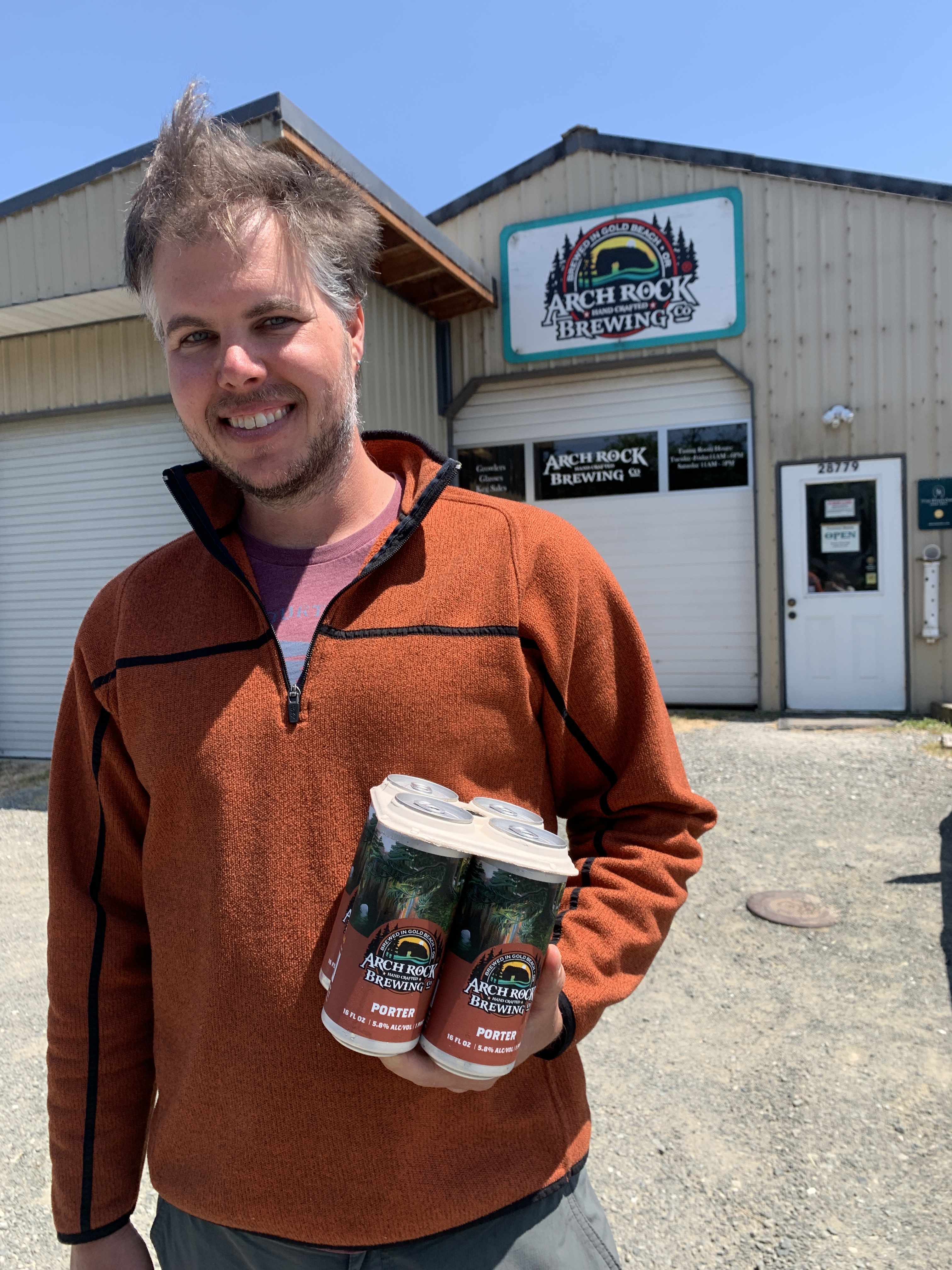
Onward and upward, on the map at least. Our last stop—well, my last stop—was Arch Rock Brewing. Not for its frills; the tasting room is barely that. You stop in, have a sample or two, buy your cans and go drink them at the beach or something. It is primarily a production brewery, and it turns out some of the most consistently good beer in the state.
Their trick? They brew three year-round beers (a lager, pale ale, and porter), and one, maaaaaybe two seasonals. I stop here to get a mixed case for home and to say hi to Gabe, their long-time salesperson, and James, the brewer; some of the nicest folks in the biz.
Being on the coast, the Arch Rock folks are aware of the environment. They use biodegradable can rings instead of plastic, and now have printed cans as opposed to paper stickers or plastic wraps.
Home again, I immediately plotted my next coastal foray and crushed some kombu together with sesame seeds and sea salt for garnish. This was a trip with purpose beyond seeing a new place; actually tasting the wild growth of the ocean there was invigorating and immensely pleasurable, and opened up new experiences of flavor that I’ll use forever.
Infinite thanks to Liz, my love, who gifted me the seaweed class. I’d wanted to learn to forage on the coast, but did not expect this adventure. Additional thanks to Ian, the Brussat sprout, whose enthusiasm for plants and their uses is a joy to witness.
 Beerstone